


 Iridology & SclerologyBlue Eyes Meaning in Iridology: The Lymphatic Constitution

Sclerology is the traditional study of the sclera, the white of the eye, and the fine network of lines and colours that appear within it [1]. A sclerologist reads the white of each eye like a clock face and charts every fine line by where it begins, where it ends and the way it points [13]. That map is the sclerology chart. Where an iridology reading looks at the coloured iris, sclerology turns to the white that surrounds it, a changing, responsive surface.
At the Vitalist Healing Traditions Society, sclerology is a companion practice to iridology, and both belong to our guide to iridology and sclerology. Here is how the chart is drawn, how a reader moves around the whites of the eyes, and where the practice comes from.
Key takeaways
- Sclerology reads the white of the eye, noting the location, direction, shape, colour and appearance of its fine markings [1].
- The sclerology chart is read "around the clock", one quadrant at a time, with twelve o'clock at the top [13].
- Each white has a nasal side, by the nose, and a temporal side, by the temple [14].
- In the tradition, the iris speaks of what you inherit and the sclera of "what's happening now" [6].
What does a sclerologist do?
A sclerologist observes the white of the eye, charts its fine lines and reads them by the sclerology tradition. The International Iridology Practitioners Association describes the study as looking at "the location, direction, shape, color, and appearance" of the markings, with nothing touching the eye: the reader "simply observes or photographs the sclera" [1].
The titles show the training behind them. The association's certified iridologists receive foundational training in sclerology, while its certified sclerologists have "completed additional specialized training in the field" [1]. Its own sclerology program runs in two courses, foundational and advanced professional, each followed by an examination [2].
What is a sclerology chart?
A sclerology chart is a map of the whites of the eyes. Most readers draw the white as a ring around the iris and chart it like a clock face, so that, in the words of one teacher, "twelve o'clock in the sclera is twelve o'clock on your chart" [13]. Leonard Mehlmauer, who, in the IIPA's words, "has done a great deal of research in Sclerology" [4], drew his sclerology map in the eye's own outline instead, "the natural (and original with us) almond-shaped appearance of the human sclera" [5].
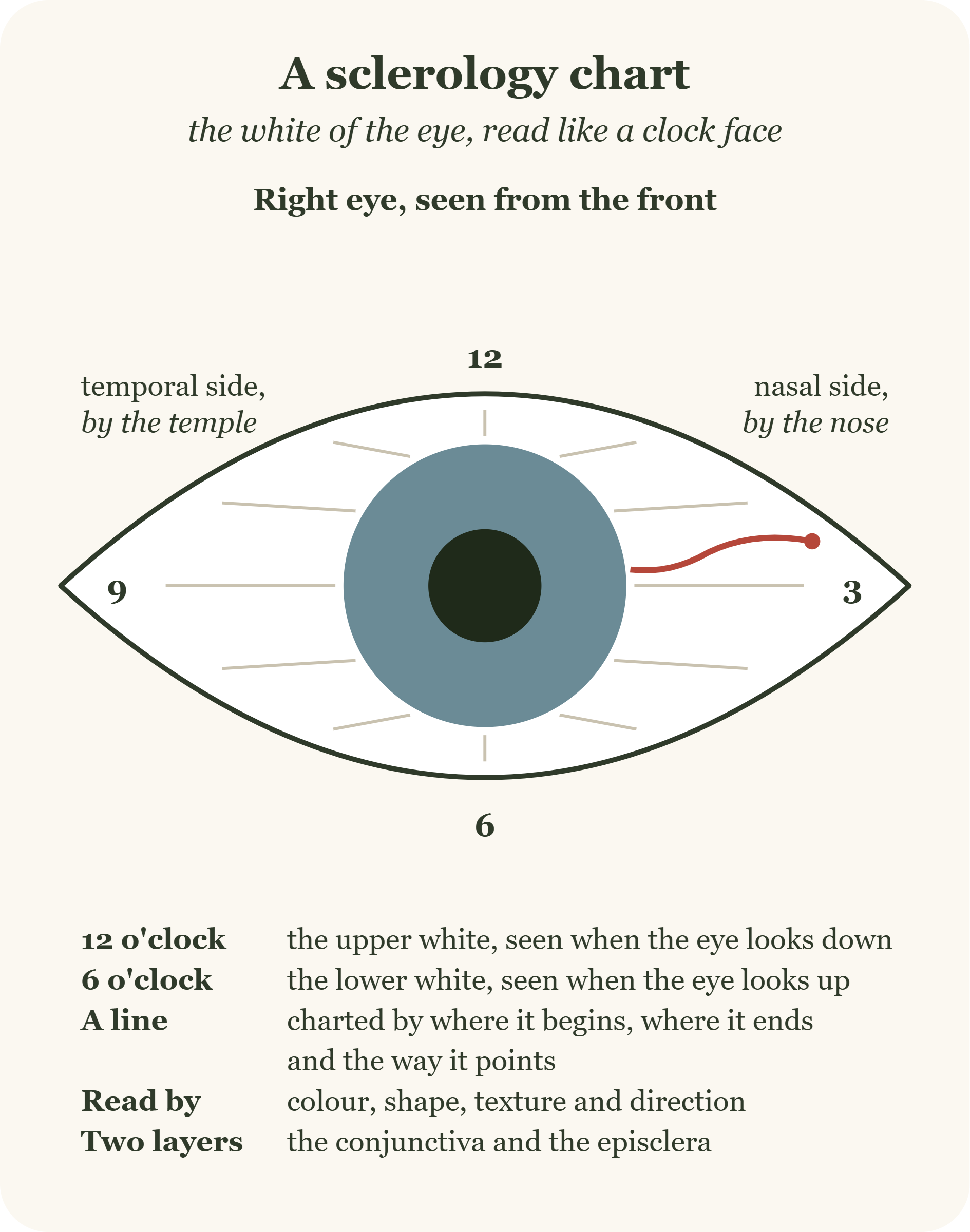
On every sclerology eye chart, the white of each eye has two sides. The inner side lies "by nose" and is called nasal; the outer side lies "by temple" and is called temporal [14]. The tradition reads two layers of the white: the conjunctiva, "the somewhat moveable membrane atop the white part", and the episclera beneath it [9].
What does a sclerology chart show?
- The clock. The white is read "around the clock", with twelve o'clock at the top [13].
- Four quadrants. The person looks straight down, up, left and right, and the in-between hours of 2, 4, 8 and 10 o'clock are checked as well [13].
- Two sides. The nasal side lies by the nose and the temporal side by the temple [14].
- Each line. Its beginning and end are marked on the chart [13], and the reader notes its location, direction, shape, colour and appearance [1].
How do you read the whites of the eyes?
A reading moves gently around the eye, one quadrant at a time. The person looks straight down so the reader can see the upper white at twelve o'clock, then straight up for the lower white at six o'clock, then to each side [13]. The reader charts each line in its quadrant "according to their o'clock points of origination and termination", checking the in-between hours as well, such as 2, 4, 8 and 10 o'clock [13].
For each line the reader notes "the location, direction, shape, color, and appearance" [1], along with its texture [7]. Direction carries particular meaning: some vessels "are straight and point directly to an adjacent segment of the iris" [14], and the tradition reads them together with the part of the iris they point toward. The tools are simple: a soft hand light and "a 4x pocket magnifier" [8].

The shapes of the lines
The tradition gives the fine vessels names by their form. Teaching handouts list indicator vessels, meandering vessels, spiral vessels, tangential vessels, netting vessels and vessel pools [14]. Mehlmauer's quick guide describes "some 82 signs and markings in the sclera and conjunctiva", "those interesting lines, gels, pigments, and other markings" [17].
The white is also the most changeable part of the eye. One teacher calls it "one of the most reactive parts of the eye, being subject to rapid change more than any other part" [7], which is why the tradition reads it for the present season of a person's life.
"The iris gives us one part of the story. The sclera gives us another. Together, they help us see the bigger picture." [1]
How do iridology and sclerology work together?
Iridology reads the coloured iris; sclerology reads the white around it. A popular summary in the tradition puts it simply: "While the irises focus on genetic predisposition, the scleras say what's happening now" [6]. One teacher calls the sclera "a wonderful partner to Iridology", best read "in the context of the whole eye" [7]. For the iris side of the picture, read our guide to the iridology reading, and for both together, our iridology and sclerology tradition page.
Where does sclerology come from?
Readers of the sclera point first to China. In Chinese eye reading, the white of the eye belongs to the Qi sphere, qi lun, and "relates to the lung", one of the Five Wheels of the eye [15]. A second map, the Eight Regions, divides the outer eye into eight parts named after "eight natural phenomena, or the Eight Trigrams" [16]. Both appear as woodcuts in a 1901 edition of Gu Shicheng's seventeenth-century text Yangyi daquan [15].
Modern sclerology took shape in the United States. Leonard Mehlmauer, a traditional naturopath whose work began "in 1972 in San Diego" [8], wrote the field's manual, Sclerology: A New View of an Ancient Art, which was in its fourth edition by 1997 [11]. In 1995 he coined the word "Eyology" for the family of eye reading arts that includes sclerology [9]. Jack Tips published a sclerology certification course in 1993 [12], and Bernard Jensen, the great teacher of iridology, recommended Mehlmauer's book to anyone who wanted to know more about sclerology [17].
Today the IIPA, founded in 1982 as the National Iridology Research Association [3], carries the work forward with foundational and advanced sclerology courses [2], and Mehlmauer's school has handed its sclerology certification to the association [8]. Mehlmauer himself served on its board [4].

By the numbers
How does the Society use sclerology?
We place a sclera reading beside iridology, face reading, your history and your goals. The presence, direction and shape of the fine vessels are always interpreted in the context of the whole person, and shifts in the tone and clarity of the white are read as gentle signals about vitality and the body's current terrain. From that fuller picture, and a Whole Reading, we offer individualised suggestions, always in your hands.
| Practice | Family | What it reads | Read more |
|---|---|---|---|
| Sclerology | Iridology & Sclerology | The whites of the eyes and their fine lines | Iridology and sclerology |
| Iridology | Iridology & Sclerology | The iris, read as a map of constitution | Iridology reading |
| Face reading | Chinese medicine | Colour, lustre and the five zones of the face | Face reading |
| The Five Wheels | Chinese medicine | The eye in five spheres, the white as the Qi sphere | Chinese Medicine |
| The vitalist view | Naturopathy | Terrain and the body's own healing force | The vitalist approach |
For the wider picture of this tradition, read our guide to naturopathy.
WATCH THE LESSON
In this 13-minute lesson Dr. Carina Lopez reads the whites of the eyes beside the iris, the face and the tongue, and shows how all three windows point to one root pattern.
Read the full guide: Reading the Body, with the tongue map and the research behind each window
Frequently asked questions
What is a sclerology chart?
It is a map of the white of the eye. The tradition reads the white of each eye like a clock face and charts each fine line by where it begins, where it ends and the way it points [13]. Mehlmauer's sclerology map follows the eye's own almond shape [5].
What does a sclerologist do?
A sclerologist observes the white of the eye and charts its lines "around the clock" [13], noting the location, direction, shape, colour and appearance of each mark [1].
How do you become a certified sclerologist?
The International Iridology Practitioners Association runs a foundational course with an online examination, which leads to certification as a Foundational Sclerologist, and an advanced professional course that builds upon it [2].
How do you read the whites of the eyes in sclerology?
One quadrant at a time. The person looks down, up and to each side while the reader charts each line by its clock hours, then notes its colour, shape, texture and direction [1] [7] [13], using a soft light and a small magnifier [8].
What is the difference between iridology and sclerology?
Iridology reads the coloured iris; sclerology reads the white of the eye and its fine vessels. In the tradition the iris speaks of what is inherited and the sclera of "what's happening now", and the two are read together [1] [6].
Who developed sclerology?
Modern sclerology grew up in the United States in the late twentieth century. Leonard Mehlmauer, a traditional naturopath whose school began in San Diego in 1972, wrote the field's manual and coined "Eyology" in 1995 [8] [9]; Jack Tips published a sclerology course book in 1993 [12].
Does sclera reading have older roots?
Its readers point to China, where the Five Wheels give the white of the eye to the Lung and the Eight Regions divide the outer eye into eight parts named after the Eight Trigrams, both shown in woodcuts from a 1901 edition of a seventeenth-century text [15] [16].
Sources
- International Iridology Practitioners Association. What Is Iridology? What Is Sclerology?
- International Iridology Practitioners Association. Sclerology.
- International Iridology Practitioners Association. What Is IIPA?
- Tart-Jensen E. IIPA History and My IIPA Vision. iridologyassn.org.
- International Iridology Practitioners Association. Educational Materials: the Integrated Iridology Sclera Chart (Toni Miller) and the Sclerology Map (Leonard Mehlmauer).
- International Iridology Practitioners Association. Books: Mehlmauer L, Sclerology: A New View of an Ancient Art.
- Miller T. The Sclera. Integrated Iridology, iridologyonline.com.
- Grand Medicine. FAQ. eyology.com, archived 13 December 2025.
- Grand Medicine. Eyology. eyology.com, archived 25 January 2026.
- Mehlmauer L. Sclerology MapBook. Grand Medicine Books; eyology.com, archived 7 February 2026.
- Mehlmauer L. Sclerology: A New View of an Ancient Art, 4th edition. Camarillo, California; 1997. Library of Congress record via Open Library.
- Tips J. The Art and Science of Sclerology: Certification Course. Austin, Texas: International Sclerology Foundation; 1993.
- Tips J. How To Chart The Sclera. Reposted on Modern and Multidimensional Iridology, 2008.
- Joyful Living Services. Sclera Signs, teaching note pages.
- Wellcome Collection. Chinese woodcut: the five spheres of the eye (wu lun), from an edition of Gu Shicheng's Yangyi daquan published in 1901.
- Wellcome Collection. Chinese woodcut: the Eight Regions of the eye (ba kuo), same 1901 edition.
- Mehlmauer L. Sclerology: A New View of an Ancient Art and Sclerology Signs and Markings Guide. Grand Medicine Books; archived December 2025 and January 2026.
This article is for educational purposes only and is not medical advice. The practice described is a traditional assessment method. Nothing here is intended to diagnose, treat, cure, or prevent any disease, or to replace evaluation by a licensed healthcare provider. Please consult a qualified professional regarding your health, including any change in your eyes.
Images: featured painting, Agnolo Bronzino, Portrait of Lucrezia Panciatichi, about 1540. Uffizi Gallery, Florence, public domain, via Wikimedia Commons. In-article photographs credited in their captions.

The Journal
Explore Iridology & SclerologyContinue Reading
Iridology & SclerologyBlue Eyes Meaning in Iridology: The Lymphatic Constitution Iridology & SclerologyIridology Reading: What a Reading Shows, From the Pupil Outward
 HerbalismWhat Is Spagyric? Herbal Alchemy and the Spagyric Tincture